- Best Critical Care Injectable Company
- +91 8527187932
- info@jbansicucare.com

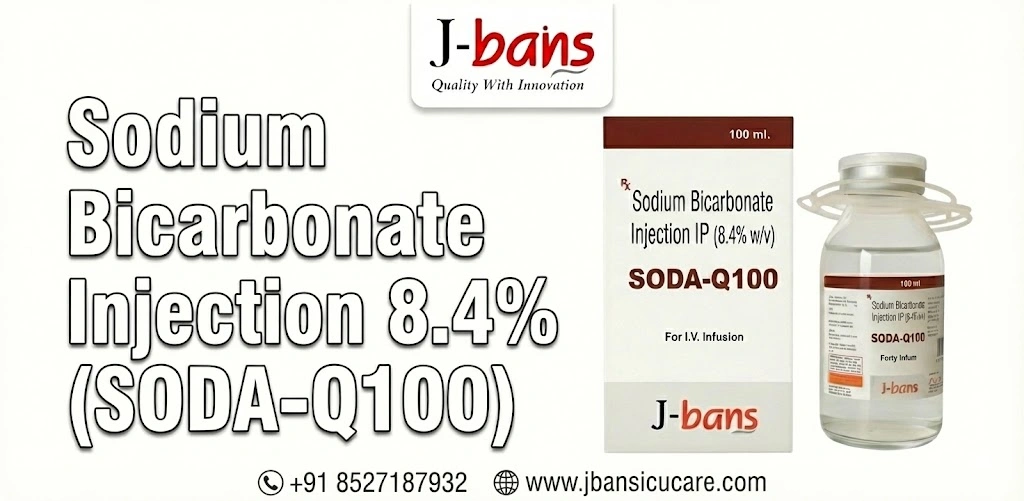
Sodium Bicarbonate Injection 8.4% (SODA-Q100)

Injection Manufacturing Company In India
December 17, 2025
Critical Care Injection manufacturers in Delhi
December 19, 2025Sodium Bicarbonate Injection 8.4% (SODA-Q100): A Vital Critical Care Solution for Metabolic Acidosis and Beyond
In the fast-paced world of critical care medicine, having reliable and effective treatments can make all the difference between life and death. Sodium Bicarbonate Injection 8.4% (SODA-Q100) stands out as a cornerstone therapy for managing metabolic acidosis and other emergency conditions. Produced by J-BANS ICU Care, a leading name in injectable pharmaceuticals, this product exemplifies innovation and quality in ICU settings. Whether you’re a healthcare professional, distributor, or entrepreneur exploring opportunities in pharma, understanding SODA-Q100’s role is essential.
J-BANS ICU Care has built its reputation on delivering life-saving medicines that meet global standards. As you explore our offerings on you’ll see a commitment to affordable, high-quality critical care solutions. This injection is part of their extensive range designed for intensive care units, where rapid intervention is crucial.
What is Sodium Bicarbonate Injection 8.4%?
Sodium Bicarbonate Injection IP (8.4% w/v) is a sterile, hypertonic solution used primarily as an alkalizing agent. It contains sodium bicarbonate as the active ingredient, which helps restore acid-base balance in the body. Marketed under the brand name SODA-Q100, this 100 ml vial is specifically formulated for intravenous (I.V.) infusion.
The product’s packaging features a clear label with essential details: “Sodium Bicarbonate Injection IP (8.4% w/v)” and “For I.V. Infusion.” The vial is designed for easy handling in high-pressure environments like ICUs, ensuring quick access during emergencies.
This formulation is particularly potent, with each milliliter providing 1 mEq of sodium and bicarbonate ions. It’s preserved in a glass bottle to maintain stability and purity, reducing the risk of contamination.
Key Composition and Formulation Details
Understanding the makeup of SODA-Q100 is vital for its safe use. Here’s a breakdown in table format for clarity:
| Component | Details |
| Active Ingredient | Sodium Bicarbonate (8.4% w/v) |
| Strength | 84 mg/ml (1 mEq/ml each of Na+ and HCO3-) |
| Volume | 100 ml |
| pH Range | 7.0 – 8.5 |
| Osmolarity | Approximately 2000 mOsm/L |
| Excipients | Water for Injection |
| Packaging | Glass vial with rubber stopper |
This composition ensures rapid action when administered, making it ideal for critical scenarios.
Primary Uses and Indications of Sodium Bicarbonate Injection 8.4%
Sodium Bicarbonate Injection 8.4% is indispensable in treating metabolic acidosis, a condition where the body produces too much acid or can’t remove it efficiently. Common causes include severe renal disease, uncontrolled diabetes, and circulatory shock.
In cardiac arrest situations, it’s used to counteract acidosis during resuscitation efforts. It also aids in managing drug intoxications, such as from barbiturates or salicylates, by alkalinizing urine to enhance excretion.
For severe diarrhea leading to bicarbonate loss, SODA-Q100 helps restore electrolyte balance. In extracorporeal circulation procedures like dialysis, it prevents acid buildup.
Beyond these, it’s employed in primary lactic acidosis and certain cases of hyperkalemia, where shifting potassium into cells is necessary.
How Sodium Bicarbonate Injection Works
The mechanism of action is straightforward yet powerful. Sodium bicarbonate dissociates into sodium and bicarbonate ions upon infusion. The bicarbonate ion buffers excess hydrogen ions, converting them into carbonic acid, which then breaks down into water and carbon dioxide.
This process raises blood pH, alleviating acidosis symptoms like fatigue, confusion, and rapid breathing. In critical care, this rapid correction can stabilize patients, allowing time for addressing underlying issues.
However, it’s not a standalone treatment—it’s often combined with other therapies like fluids or insulin in diabetic ketoacidosis.
Dosage and Administration Guidelines
- Dosage must be individualized based on the patient’s acid-base status, monitored via arterial blood gases. For adults in cardiac arrest, an initial dose of 1 mEq/kg IV is common, followed by 0.5 mEq/kg every 10 minutes if needed.
- In metabolic acidosis, calculate the bicarbonate deficit using the formula: Bicarbonate deficit (mEq) = 0.5 x body weight (kg) x (24 – serum bicarbonate).
- Administer slowly via IV infusion to avoid complications. Dilute if necessary, and never mix with calcium-containing solutions to prevent precipitation.
- For pediatric patients, doses are lower—typically 0.5-1 mEq/kg, adjusted carefully.
- Always consult lab results before repeating doses to prevent overcorrection.
Potential Side Effects and Adverse Reactions
- While effective, SODA-Q100 can cause side effects if not used properly. Common ones include metabolic alkalosis, leading to muscle twitching, irritability, or tetany.
- Hypernatremia may occur, causing fluid retention, edema, or hypertension. In patients with heart failure, this could exacerbate symptoms.
- Local reactions at the injection site, like pain or tissue necrosis from extravasation, are possible. Rapid infusion might lead to hyperosmolarity, resulting in headaches or confusion.
- Rare but serious effects include hypocalcemia or hypokalemia, so electrolyte monitoring is crucial.
Precautions and Contraindications
- Use caution in patients with congestive heart failure, renal impairment, or those on corticosteroids, as it can worsen sodium retention.
- Contraindicated in respiratory or metabolic alkalosis, hypocalcemia, or when there’s risk of chloride loss.
- Pregnant or lactating women should use only if benefits outweigh risks—consult a physician.
- Store at room temperature, protected from light, and check for particulates before use.
SODA-Q100 as a Critical Care Product
In the realm of critical care, where every second counts, SODA-Q100 shines as an emergency intervention tool. It’s part of J-BANS ICU Care’s lineup of life-saving injections, designed for ICUs, emergency rooms, and ambulances.
Critical care demands products that are reliable, fast-acting, and backed by rigorous testing. This injection fits perfectly, helping manage acidosis in trauma, sepsis, or post-surgical complications.
Hospitals rely on such formulations to improve patient outcomes, reducing mortality in acidotic states.
Benefits in Critical Care Settings
- Rapid Acid-Base Correction: Restores pH balance quickly, stabilizing vital signs.
- Versatility: Useful in diverse scenarios from cardiac arrest to toxin management.
- Compatibility: Can be integrated into standard ICU protocols.
- Cost-Effective: Affordable option without compromising efficacy.
These advantages make it a staple in critical care pharmacopeias worldwide.
J-BANS ICU Care: Pioneers in Critical Care Pharmaceuticals
- J-BANS ICU Care is dedicated to advancing critical care through innovative injectables. Their focus on electrolyte balance products like SODA-Q100 underscores their expertise.
- As a zero-debt company, they invest heavily in quality, ensuring products like this injection meet the highest standards.
Exploring PCD Franchise Opportunities in Critical Care
- For entrepreneurs eyeing the pharma sector, a critical care PCD franchise offers immense potential. J-BANS ICU Care provides a transparent model with monopoly rights, allowing exclusive distribution in your territory.
- Partnering with a critical care PCD company in India like J-BANS means accessing high-demand products with higher margins and less competition.
- This franchise supports low investment starts, from ₹20,000–₹50,000, making it accessible for new entrants.
Support Provided in PCD Franchise
J-BANS ICU Care excels in franchise support, offering 24/7 assistance and comprehensive promotional materials.
- Free samples and publicity kits to kickstart marketing.
- Training on product knowledge and sales strategies.
- Strong supply chain for timely deliveries.
- Ethical practices ensuring long-term partnerships.
Such backing helps franchisees build profitable businesses in the growing critical care market.
Monopoly Rights Explained (PCD Business Perspective)
In a PCD model, monopoly rights mean that only one authorized franchise partner can market and distribute SODA-Q100 in a defined geographic area.
What Monopoly Rights Mean Practically
- No internal competition within your territory
- Exclusive rights to approach hospitals, ICUs, and distributors
- Brand control and long-term relationship building
Territory Protection Benefits
- Stable pricing without undercutting
- Predictable monthly demand
- Strong brand recall among doctors and hospitals
Hospital & ICU Exclusivity Advantage
- Preferred supplier positioning
- Easier repeat orders
- Strong institutional trust
Indicative Margin Structure & Business Potential
Distributor Margin Range
- Average margins: 20%–30% depending on volume
- Higher margins on institutional bulk orders
PCD Franchise ROI Timeline
- Break-even typically within 6–9 months
- Faster ROI due to repeat ICU consumption
Repeat Order Cycle in Critical Care
- High reorder frequency (monthly / bi-monthly)
- Emergency demand ensures consistent movement
- Long-term hospital contracts increase stability
Product Distribution and Dealership Opportunities
- Distribution of SODA-Q100 and similar products is streamlined through J-BANS’s nationwide network. Dealerships benefit from competitive pricing and consistent supply.
- Interested parties can explore the full catalog on our products page, which includes injections, infusions, antibiotics, and more.
- As a dealer, you’ll handle high-quality items like electrolyte solutions, catering to hospitals and clinics.
How to Become a Dealer or Distributor
- Starting is simple: Reach out via our contact section to discuss dealership terms.
- They offer flexible agreements, focusing on mutual growth. With India’s critical care market expanding, dealerships provide stable income streams.
- Benefits include exclusive territories, volume discounts, and marketing support.
Quality Assurance and R&D at J-BANS ICU Care
- Quality is non-negotiable in critical care. J-BANS ensures SODA-Q100 undergoes strict checks, from raw materials to final packaging.
- Their in-house R&D center, approved by DSIR under the Ministry of Science & Technology, drives innovation. Learn more about their processes on the quality and R&D page, where they detail advanced protocols for stability and safety.
- Partnerships with top manufacturers like Akums Drugs ensure WHO-GMP compliance.
Company Background and Values
- Founded with a vision to enhance India’s critical care landscape, J-BANS ICU Care emphasizes integrity, innovation, and customer-centricity.
- Dive deeper into our story on the about us section, highlighting our mission to provide affordable, effective medicines.
- As a research-driven entity, they continually update formulations based on global standards.
Visual Insights into Manufacturing
- To appreciate the precision behind SODA-Q100, check out images of our facilities and processes in the gallery. These visuals showcase state-of-the-art equipment and quality controls.
- Such transparency builds trust among partners and end-users.
Market Demand for Critical Care Products in India
- India’s healthcare sector is booming, with critical care needs rising due to increasing chronic diseases and accidents.
- Products like Sodium Bicarbonate Injection see steady demand in ICUs, where acidosis management is routine.
- PCD models capitalize on this, offering profitable avenues with minimal risk.
Advantages of Investing in Critical Care PCD
- High Profit Margins: Less competition means better returns.
- Growing Market: Urbanization and health awareness fuel demand.
- Government Support: Initiatives for better healthcare infrastructure.
- Innovation Opportunities: Access to new formulations.
These factors make it a smart business choice.
Challenges and How to Overcome Them
- While rewarding, the sector has hurdles like regulatory compliance and supply chain issues.
- J-BANS mitigates these with robust support and certifications, ensuring smooth operations for franchisees.
Integrating SODA-Q100 into Hospital Protocols
- Hospitals can incorporate this injection into acidosis management guidelines, ensuring staff training for optimal use.
- Its compatibility with other IV fluids makes it versatile.
Comparison with Similar Products
Here’s a table comparing SODA-Q100 with generic alternatives:
| Feature | SODA-Q100 (J-BANS) | Generic Brands |
| Concentration | 8.4% w/v | 8.4% w/v |
| Packaging | 100 ml vial | Varies (50-100 ml) |
| Certifications | WHO-GMP, ISO | May vary |
| Price Point | Competitive | Often lower but inconsistent quality |
| Support | Full PCD backing | Limited |
J-BANS stands out for reliability.
Storage and Shelf Life
- Store at 15-30°C, away from light. Shelf life is typically 24 months from manufacturing.
- Discard if solution is discolored or contains particles.
Environmental Impact and Sustainability
- J-BANS prioritizes eco-friendly manufacturing, minimizing waste in production.
- This aligns with global sustainability goals in pharma.
Future Trends in Critical Care Injections
- Expect advancements like pre-filled syringes for faster administration.
- J-BANS is poised to lead with their R&D focus.
FAQs
What is Sodium Bicarbonate Injection used for?
Primarily for treating metabolic acidosis in conditions like renal failure or diabetes.
How is SODA-Q100 administered?
Via slow IV infusion, based on blood gas monitoring.
What are the side effects of this injection?
Possible metabolic alkalosis, hypernatremia, or local irritation.
Is it safe during pregnancy?
Use only if necessary; consult a doctor.
What is the dosage for cardiac arrest?
Initial 1 mEq/kg IV, adjusted per lab results.
How does J-BANS ensure product quality?
Through WHO-GMP manufacturing and R&D checks.
What is a PCD franchise?
Propaganda Cum Distribution model for pharma marketing.
What support does J-BANS provide to franchisees?
Monopoly rights, promotional materials, and 24/7 assistance.
How much investment is needed for dealership?
Starts from ₹20,000–₹50,000.
Can I distribute SODA-Q100 exclusively in my area?
Yes, with monopoly rights.
What other critical care products does J-BANS offer
Injections, infusions, antibiotics, and electrolytes.
How to contact J-BANS for franchise inquiries?
Via phone, WhatsApp, or email.
What is the shelf life of SODA-Q100?
Typically 24 months.
Are there precautions for storage?
Keep at room temperature, away from light.
Why choose critical care PCD in India?
High demand, profitable margins, and growing market.
Conclusion
Sodium Bicarbonate Injection 8.4% (SODA-Q100) from J-BANS ICU Care represents excellence in critical care pharmaceuticals. Its role in managing life-threatening acidosis, combined with business opportunities in PCD franchises, makes it a dual powerhouse for health and entrepreneurship. Whether you’re seeking reliable treatments or profitable ventures, J-BANS delivers. Explore their ecosystem today and join a network committed to saving lives.