- Best Critical Care Injectable Company
- +91 8527187932
- info@jbansicucare.com

Top 10 Critical Care Injections for Hospitals

Critical Care Injectable Company in Gujarat
August 20, 2026
Top 10 Ethical Pharma Companies in India (2026)
September 18, 2026Top 10 Critical Care Injections for Hospitals | J-BANS ICU CARE PVT. LTD.
In acute healthcare, speed and precision define the boundary between survival and adverse clinical outcomes. Intensive Care Units (ICUs), Emergency Departments (EDs), and Operation Theatres (OTs) depend heavily on fast-acting critical care injections. When a patient experiences septic shock, acute respiratory distress, severe trauma, or cardiac arrest, oral medications are often unsuitable due to delayed absorption or altered gastrointestinal perfusion.
Having a well-stocked inventory of critical care pharmaceutical products allows clinicians to stabilize hemodynamic parameters, manage organ dysfunction, and address life-threatening complications within seconds. For hospital administrators, procurement officers, and healthcare professionals, maintaining an uninterrupted supply of reliable hospital injections is a core operational requirement.
Specialized companies like J-BANS ICU CARE PVT. LTD. support India’s healthcare infrastructure by providing parenteral formulations designed for high-stakes medical environments.
What Are Critical Care Injections?
Critical care injections are sterile, highly concentrated pharmaceutical solutions or powders for reconstitution designed for intravenous (IV), intramuscular (IM), or subcutaneous administration in urgent medical settings.
In acute care settings, injectable delivery offers distinct physiological advantages:
- 100% Bioavailability: Intravenous delivery bypasses the gastrointestinal tract and first-pass hepatic metabolism, placing the active drug directly into systemic circulation.
- Immediate Pharmacodynamic Response: Onset occurs within seconds to minutes, which is essential during hemodynamic collapse or acute anaphylaxis.
- Controlled Titration: Continuous infusions allow clinicians to adjust drug delivery microgram-by-microgram based on real-time physiological monitoring.
Professional Supervision, Storage, and Handling
Because ICU injections carry high pharmacologic potency, they are classified as high-alert medications. Administration must strictly follow verified clinical protocols, bedside monitoring, and dosage verification by trained healthcare professionals.
Quality assurance in critical care pharmaceutical products relies on cold-chain integrity, light-protected storage, and aseptic handling. Storage temp variations or particulate contamination can compromise drug efficacy or compromise patient safety. Consequently, hospital procurement teams seek critical care injection manufacturers that enforce stringent sterility testing and compliant packaging.
Top 10 Critical Care Injections for Hospitals
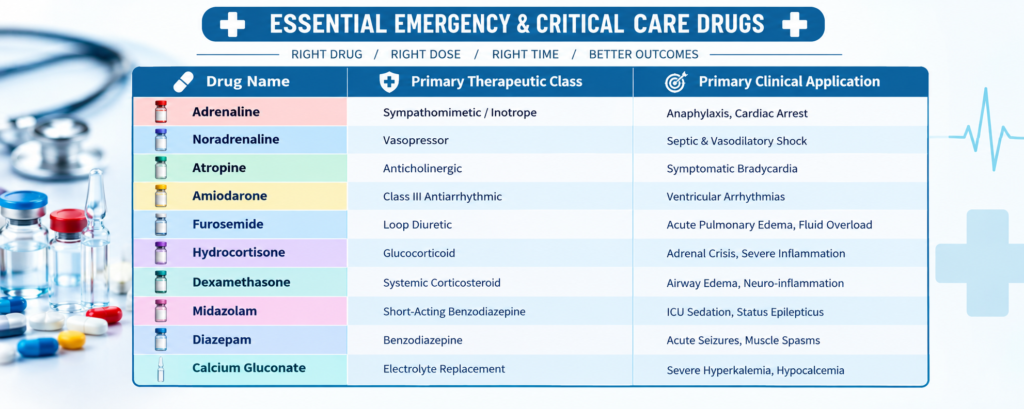
The selection of emergency injections in an ICU or emergency department depends on patient pathology, hospital formulary guidelines, and clinical discretion. Below are 10 widely recognized injectable pharmaceutical products
that form the backbone of critical care management.
1. Adrenaline (Epinephrine)
- Generic Name: Adrenaline Bitartrate / Epinephrine
- General Clinical Role: Direct-acting sympathomimetic agonist that stimulates both alpha- and beta-adrenergic receptors.
- Hospital Applications: Essential in resuscitation algorithms for cardiac arrest, severe anaphylactic shock, acute bronchospasm, and profound hypotension.
- Storage & Handling: Light-sensitive; requires protection from direct exposure and monitoring for oxidative discoloration.
2. Noradrenaline (Norepinephrine)
- Generic Name: Noradrenaline Acid Tartrate / Norepinephrine
- General Clinical Role: Potent peripheral alpha-1 vasoconstrictor with modest beta-1 inotropic activity.
- Hospital Applications: First-line vasopressor therapy for restoring mean arterial pressure (MAP) in septic shock, cardiogenic shock, and vasodilatory state management.
- Storage & Handling: Typically diluted in dextrose-containing solutions and administered via central line to prevent peripheral extravasation and tissue necrosis.
3. Atropine
- Generic Name: Atropine Sulphate
- General Clinical Role: Muscarinic acetylcholine receptor antagonist.
- Hospital Applications: Used to treat hemodynamically unstable symptomatic bradycardia, AV nodal blocks, and organophosphate insecticide poisoning.
- Storage & Handling: Store at controlled room temperature; inspect vials for clarity prior to administration.
4. Amiodarone
- Generic Name: Amiodarone Hydrochloride
- General Clinical Role: Class III antiarrhythmic agent that prolongs myocardial cell action potential duration and refractory period.
- Hospital Applications: Management of unstable ventricular tachycardia (VT), ventricular fibrillation (VF) refractory to defibrillation, and atrial tachyarrhythmias.
- Storage & Handling: Protect from light; requires slow IV infusion or continuous monitoring during administration to reduce the risk of phlebitis and hypotension.
5. Furosemide
- Generic Name: Furosemide
- General Clinical Role: High-ceiling loop diuretic that inhibits sodium and chloride reabsorption in the thick ascending limb of the loop of Henle.
- Hospital Applications: Management of acute pulmonary edema, fluid overload secondary to congestive heart failure, acute renal dysfunction, and severe hypertension.
- Storage & Handling: Light-sensitive; do not mix in highly acidic solutions to prevent precipitation.
6. Hydrocortisone
- Generic Name: Hydrocortisone Sodium Succinate
- General Clinical Role: Short-acting systemic corticosteroid with anti-inflammatory, immunosuppressive, and mineralocorticoid activity.
- Hospital Applications: Treatment of acute adrenal insufficiency, refractory septic shock, severe allergic reactions, and acute exacerbations of asthma.
- Storage & Handling: Reconstituted solutions should be used promptly according to manufacturer guidance to maintain drug potency.
7. Dexamethasone
- Generic Name: Dexamethasone Sodium Phosphate
- General Clinical Role: Long-acting, highly potent glucocorticoid with minimal mineralocorticoid activity.
- Hospital Applications: Management of cerebral edema, airway inflammation, croup, severe respiratory distress, and chemotherapy-induced nausea.
- Storage & Handling: Store at controlled room temperature; protect from freezing and direct light.
8. Midazolam
- Generic Name: Midazolam Hydrochloride
- General Clinical Role: Short-acting benzodiazepine that enhances central gamma-aminobutyric acid (GABA) activity.
- Hospital Applications: Procedural sedation, induction of anesthesia, continuous sedation for mechanically ventilated ICU patients, and control of status epilepticus.
- Storage & Handling: Controlled substance subject to regulatory track-and-trace requirements; monitor respiratory effort continuously during use.
9. Diazepam
- Generic Name: Diazepam
- General Clinical Role: Intermediate-acting benzodiazepine with anticonvulsant, anxiolytic, and central muscle relaxant properties.
- Hospital Applications: Acute management of prolonged seizures, status epilepticus, acute alcohol withdrawal syndromes, and muscle spasms.
- Storage & Handling: Slow IV injection recommended; protect solutions from absorption into specific plastic IV tubing systems where applicable.
10. Calcium Gluconate
- Generic Name: Calcium Gluconate
- General Clinical Role: Intravenous electrolyte solution.
- Hospital Applications: Cardioprotection in severe hyperkalemia, acute symptomatic hypocalcemia, hypermagnesemia, and calcium channel blocker toxicity.
- Storage & Handling: Administer slowly under cardiac monitoring; inspect visually for salt precipitation prior to infusion.
How Hospitals Can Select Critical Care Injections
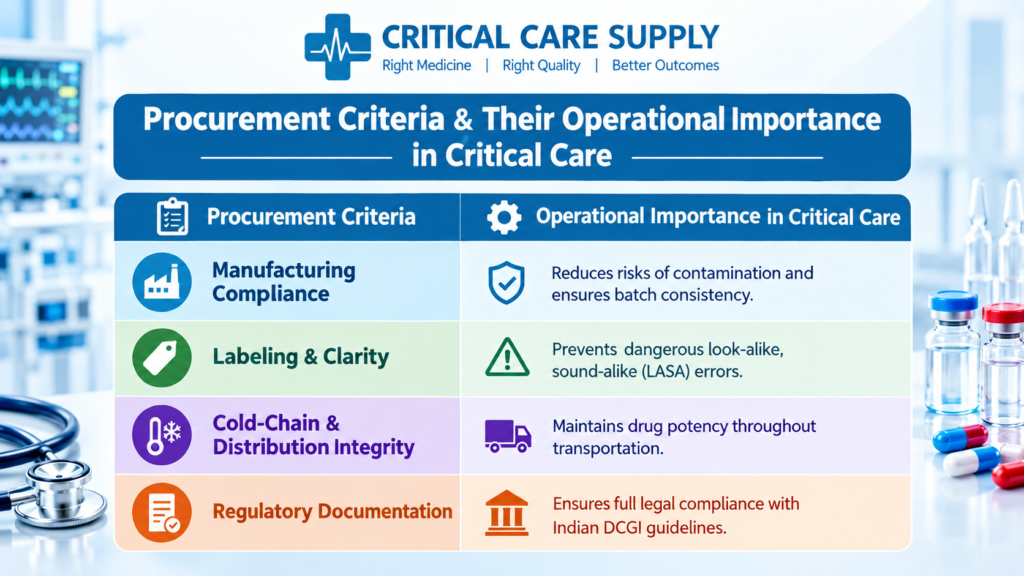
Procuring critical care medicines for hospital formularies requires strict vendor screening. Because ICU medicines leave no margin for error, clinical purchase committees evaluate suppliers against stringent parameters:
- Quality Standards & Certifications: Products should originate from facilities complying with WHO-GMP and ISO standards.
- Packaging Integrity: Vials and ampoules must feature tamper-evident seals, clear labeling, and scannable barcode systems for bedside administration safety.
- Supply Reliability: Critical care units require stable stock supply to avoid shortages of life-saving injectable medicines for hospitals.
- Batch Traceability: Comprehensive Certificate of Analysis (CoA) documentation and batch tracking ensure transparency.
- Formulary Compatibility: Injectable concentrations and pack sizes should align with established hospital infusion protocols to simplify clinical workflows.
Role of Pharmaceutical Manufacturers in Critical Care
The availability of life-saving critical care pharmaceutical products depends on high-precision manufacturing infrastructure. Sterility assurance, pyrogen testing, automated filling lines, and strict quality control protocols ensure that each batch meets regulatory pharmacopeial standards.
J-BANS ICU CARE PVT. LTD. operates in this specialized sector, manufacturing and supply-chaining critical care injections for hospitals across India. By focusing on high-potency parenteral formulations—such as vasopressors, antibiotics, sedatives, and electrolyte correctives—J-BANS ICU CARE PVT. LTD. supports hospitals, ICU networks, and pharmaceutical distributors with consistent, quality-tested critical care injections.
Reliable manufacturing partners help healthcare institutions minimize stockout risks, maintain formulary readiness, and focus on delivering care.
Conclusion
A well-maintained formulary of critical care injections is foundational to modern emergency medicine and intensive care. Agents such as adrenaline, noradrenaline, furosemide, and calcium gluconate allow clinical teams to respond quickly to acute pathophysiological crises.
Drug selection, dosing schedules, and administration routes must always be determined by qualified healthcare professionals according to individual patient pathology and hospital protocols. Partnering with established providers like J-BANS ICU CARE PVT. LTD. helps Indian healthcare facilities secure high-quality hospital injections for their critical care units.
Frequently Asked Questions (FAQs)
Q1: Why are critical care injections preferred over oral medications in ICU settings?
In critical care scenarios, speed and complete absorption are paramount. Critical care injections deliver drugs directly into systemic circulation (providing 100% bioavailability), resulting in an immediate therapeutic onset. This allows clinicians to rapidly stabilize unstable patients, manage severe shock, and precisely titrate drug dosages in real time—outcomes that oral medications cannot achieve due to variable gastrointestinal absorption and delayed metabolism.
Q2: How should hospitals store and handle high-alert ICU injections to maintain potency?
High-alert ICU injections must be stored according to manufacturer guidelines, which often require temperature-controlled cold chains (2°C to 8°C for sensitive formulations) or protection from direct light to prevent drug degradation. Hospitals should maintain aseptic storage environments, enforce strict inventory rotation (FIFO), and use tamper-evident packaging to prevent contamination or medication errors.
Q3: What regulatory and quality standards should hospitals check when sourcing hospital injections?
When evaluating critical care injection manufacturers, hospital procurement committees should verify compliance with World Health Organization Good Manufacturing Practices (WHO-GMP), ISO quality certifications, and Central Drugs Standard Control Organisation (CDSCO) approvals. Additionally, vendors should provide batch-specific Certificates of Analysis (CoA) and demonstrate robust supply-chain traceability.
Q4: Can any of these critical care injections be administered without continuous clinical monitoring?
No. Due to their high pharmacologic potency and immediate effect on vital functions—such as blood pressure, heart rate, and respiratory drive—critical care injections should strictly be administered by or under the direct supervision of qualified healthcare professionals following established hospital protocols and real-time patient monitoring.
Q5: How does J-BANS ICU CARE PVT. LTD. support hospitals with critical care pharmaceutical products?
J-BANS ICU CARE PVT. LTD. specializes in manufacturing and supplying high-quality, sterile injectable pharmaceutical products tailored for ICUs, emergency rooms, and operation theatres across India. By maintaining strict quality control, compliance with regulatory standards, and dependable distribution networks, J-BANS helps healthcare institutions maintain an uninterrupted supply of essential critical care medicines.